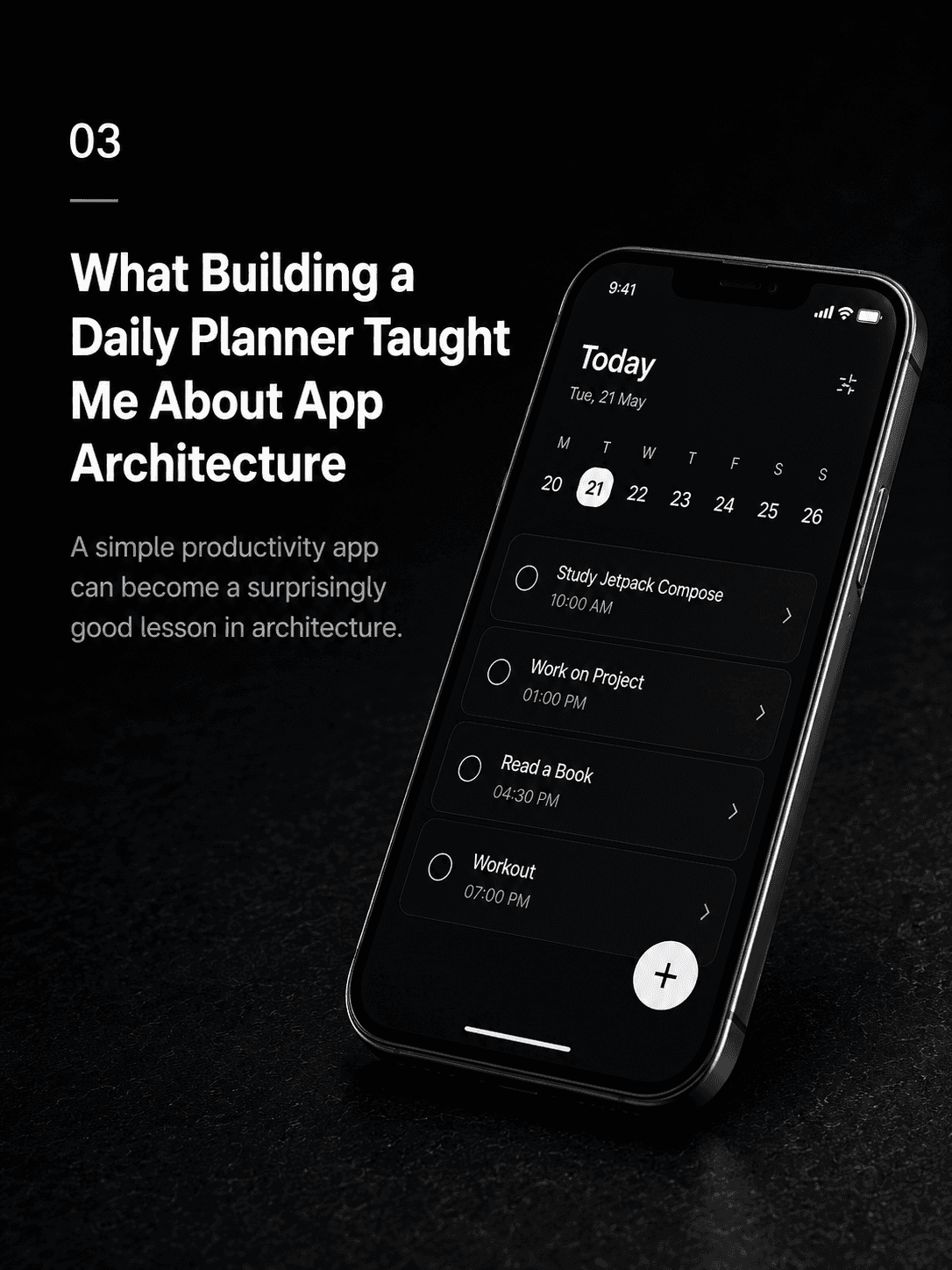
What Building Real Projects Taught Me About Writing Code?
The more I build, the more I realize that good software is not just about getting the right output. It is about making decisions that keep the system understandable, reliable, and useful long after the first version works.
4 min read

When I started learning software development, my definition of good code was fairly simple: if it worked, I considered it successful.
Over time, building projects changed that perspective.
A solution can produce the correct output and still be difficult to understand, difficult to change, or fragile when something unexpected happens. Getting a project to work is important, but it is only the first step.
Working code is not always good code
It is easy to write code that solves the problem in front of you.
It is harder to write code that someone else can understand six months later.
While working on different projects, I started paying more attention to how things are structured rather than only whether they work. Naming variables clearly, separating responsibilities, handling errors properly, and avoiding unnecessary complexity may seem like small decisions, but they make a significant difference as a project grows.
I have learned that simplicity is often more valuable than cleverness.
Projects teach things tutorials cannot
Tutorials are useful for learning syntax, frameworks, and concepts. Projects are where those concepts start making sense.
When building something from scratch, there is no predefined path telling you exactly what to do next. You have to decide how the pieces should fit together, what should happen when something fails, how data should be stored, and how the system should behave when users do something you did not expect.
Those decisions are where much of the real learning happens.
A project also has a way of exposing gaps in your understanding. Something that seemed obvious while studying can become surprisingly complicated when you actually have to implement it.
I have come to see those moments as some of the most useful parts of development.
The first solution is rarely the final solution
Another thing I have learned is that writing code is an iterative process.
The first version of a feature might work, but after using it, testing it, or looking at the code again, weaknesses become obvious. Maybe the logic is unnecessarily complicated. Maybe two parts of the system are doing similar things. Maybe an edge case was overlooked.
Instead of treating the first working implementation as finished, I try to look at it as a starting point.
Refactoring is not about changing code simply for the sake of making it look cleaner. It is about improving the structure when you understand the problem better than you did when you first solved it.
Build for the person who will use it
One of the biggest shifts in my thinking has been understanding that software is ultimately built for people.
A technically impressive implementation does not matter much if the person using it finds the product confusing or unreliable.
That means engineering decisions cannot always be separated from the user experience. Performance, reliability, clear feedback, sensible defaults, and predictable behavior are all part of building a good product.
The best solution is not necessarily the one with the most features or the most complicated architecture.
It is the one that solves the actual problem well.
Still learning
I do not think there is a point where you simply become "done" learning software engineering.
Every project introduces a new problem. Every bug makes you question an assumption. Every time you revisit older code, you notice something you would approach differently today.
That is probably one of the things I enjoy most about software development.
I am still learning how to write better code, design better systems, and make better engineering decisions. But the goal has gradually changed.
I am no longer trying to write code that simply works.
I want to build software that makes sense.
Join the newsletter
Be the first to read our articles.